
Historical Reference Note: The 1828 Dictionary and Early American Racial Classification

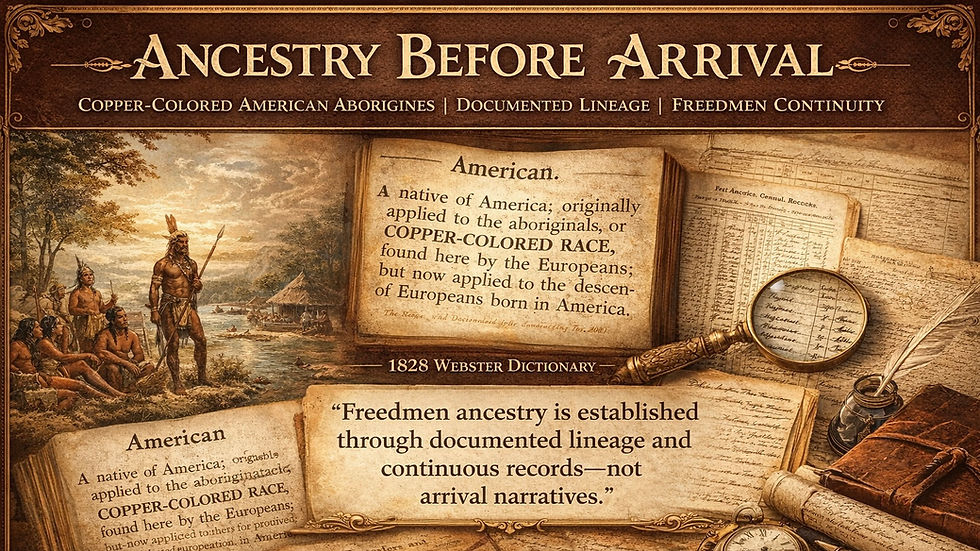
For historical accuracy and record correction, early American source material must be used—not modern racial constructs.
The American Dictionary of the English Language, compiled by Noah Webster, reflects how people were described and classified in the early United States, before later racial consolidation. In this dictionary, “copper-colored” is a recognized racial descriptor associated with the native inhabitants of the Americas, commonly identified at the time as American Aborigines.
Key historical points supported by this reference:
“Copper-colored” was a standard racial description in early U.S. language.
American Aborigine identified people indigenous to the land, present prior to European colonization.
These classifications existed before later racial labels were collapsed into the single category now called “Black.”
The language aligns with contemporaneous censuses, land records, and court documents.
Connection to Freedmen Ancestry
Freedmen ancestry is documented through continuous record linkage, not assumed origin narratives. Many Freedmen trace their lineage through:
Pre-1870 population records (including colonial-era listings)
1870 and 1880 U.S. censuses establishing family continuity after emancipation
Land, probate, and court records tying families to specific localities over generations
Enslavement-era documents that show reclassification of people already present, alongside those later transported
These records demonstrate ancestral continuity on the land, connecting Freedmen to ancestors who were present before, during, and after the enslavement period. The linkage is established through documented family lines, not symbolism.
Why the Distinction Matters
Early dictionaries were functional references used by educators, courts, and administrators. Their terminology reflects a period when origin, presence, and status were more precisely distinguished. Later racial systems—designed for administrative control—flattened these distinctions, erasing American Aborigine identity and obscuring Freedmen lineage.
The 1828 dictionary, alongside census and legal records, supports that:
Copper-colored American Aborigines were historically recognized
Their presence predates the transatlantic slave trade
Freedmen ancestry is connected through documented genealogical continuity, not a single-origin narrative
This is historical documentation, not opinion, and should be treated accordingly when discussing population origins, classification, and lineage in the United States.


Comments