
FRFT’s Heir Property Network: Building Freedmen Ownership in Lumber, Minerals, and Other Industries


The Freedmen Reparations Fund Trust (FRFT) is building an Heir Property Network by networking with existing heir property owners. We are bringing together families who already hold inherited property to explore how their land, timber, mineral interests, skills, and business relationships can support industries that benefit the Freedmen population. Lumber production and mineral opportunities are part of this vision, alongside agriculture, construction, transportation, manufacturing, and other businesses connected to our families’ assets.
Separately, FRFT is helping Verified Freedmen reclaim heir property. This work involves family research, property records, inheritance documentation, and support for the appropriate processes needed to establish and recover lawful family interests. Our mission includes preserving the heir property our population already holds and helping families reclaim property they have a documented right to recover.
These efforts work toward a shared goal: more heir property preserved within our families, more acreage connected through our network, and more industries our people can build, operate, and depend upon.
Existing Heir Property Owners Are the Foundation
Existing ownership is the foundation of the Heir Property Network. Families may already hold farmland, timberland, residential property, commercial parcels, mineral interests, or other inherited assets. Some have clear ownership records; others need help organizing shared interests and responsibilities. The network creates an opportunity for these owners to communicate, identify common goals, and consider projects that would be difficult to pursue individually.
The purpose is to reserve heir property inside the family for future generations. FRFT is not building this network so heirs can sell off family land. The goal is to help families preserve ownership, organize records, protect their interests, and use their property and resources in ways that can create income while keeping the land connected to the family line.
Helping Verified Freedmen Reclaim Heir Property
Heir property reclamation is a central part of FRFT’s work with Verified Freedmen. Families may need help locating inherited property, identifying their connection to an estate, assembling evidence of an ownership interest, or understanding what happened to property associated with their ancestors.
Our separate reclamation work focuses on helping Verified Freedmen identify and document potential property rights. That can involve genealogy, deeds, probate files, tax records, surveys, and the history of transfers. The work can concern inherited farmland, timberland, homes, commercial parcels, and associated mineral interests.
FRFT can help organize the research and documentation needed for a family’s reclamation effort, including:
Identifying heirs and Successors: Tracing family relationships and connecting descendants to the people named in property and estate records.
Locating property records: Gathering deeds, probate files, wills, tax records, surveys, maps, and other documents relevant to the family’s potential interest.
Reconstructing ownership history: Organizing the record of inheritance, transfers, divisions, and other events affecting the property.
Documenting the family’s potential claim: Preparing organized records, family information, and timelines that support review of the ownership questions involved.
Coordinating family participation: Helping relatives understand the records, identify responsibilities, and organize their efforts around a shared preservation goal.
Planning for preservation after recovery: Helping families consider records management, succession arrangements, property responsibilities, and productive uses once lawful rights are established or restored.
Some reclamation efforts may involve unresolved inheritance, incomplete estate administration, disputed ownership, or lost possession. The required process depends on the property’s history, the records, the interests involved, and the applicable law.
Freedmen status verification establishes participation status within our Institution; ownership of a particular parcel requires its own evidence and legal determination. FRFT’s research and administrative coordination support the work needed to address those property questions.
Together, these efforts address both the property our population already holds and heir property that lawful heirs may be able to recover. Existing owners can build relationships and evaluate business opportunities now. Verified Freedmen seeking reclamation can pursue a separate process grounded in their family records and circumstances.
Increasing and Preserving Heir Property Acres
FRFT is working toward increasing the acreage preserved for our families and Successors. That includes helping existing owners maintain their holdings, connecting more owners through the network, supporting lawful heir property reclamation, and evaluating future opportunities to expand family holdings.
The network can grow as additional existing heir property owners participate. That increases the acreage connected through the network. Separately, successful reclamation can restore property or ownership interests to lawful heirs, while future purchases can expand family holdings.
These results must be documented accurately. Acreage represented by participating owners, property interests recovered through reclamation, and newly acquired land describe different outcomes. Joining the network does not itself create additional land ownership.
Our goal is to connect acreage growth with lasting preservation. Property reclaimed or acquired by a family should have a plan for records, taxes, maintenance, decision-making, succession, and any approved income-producing activity.
Building Industries From Family-Owned Resources
A family may have productive acreage but lack equipment, workers, or access to buyers. Another family may own property suitable for storage, processing, or a business location. Elsewhere in our population are people with experience in agriculture, construction, transportation, accounting, technology, and sales. Networking can connect those existing resources with the people who know how to put them to work.
That is how ownership across several industries can begin to develop. Participating landowners could work with Freedmen farmers to grow food, connect production to a processing business, and develop packaging, transportation, and retail operations. Each stage creates another opportunity for ownership, employment, and income within our population.
Families whose reclamation efforts successfully restore lawful property interests may also choose to participate in the network. Their participation would remain voluntary and would depend on their ownership rights, family decisions, and the suitability of the property for a proposed activity.
Lumber, Timber, and Freedmen-Owned Supply Chains
Lumber is a major example of what this network could help develop. Participating timberland owners could connect with Freedmen-owned logging operations, sawmills, lumber drying and finishing businesses, distributors, and builders. This creates a path from standing timber to finished products such as construction lumber, flooring, cabinets, and furniture.
With enough viable supply, capital, and skilled management, families could explore ownership in the businesses that process and sell what their land produces. The opportunity extends through several stages of production, creating places for landowners, tradespeople, technical professionals, manufacturers, and business operators to participate.
Coordinated timber planning could help participating owners compare buyers, share professional services, and evaluate whether jointly owned processing equipment or a sawmill makes economic sense. Harvesting would need to follow a professional forest management plan that considers future growth, soil, water, and the family’s goals.
Timber inventories, clear boundaries, written sale contracts, and payment records are practical tools for protecting owners during a harvest. Productive timber management should support the family’s long-term ownership plan and the condition of the land that future generations will inherit.
Mineral Interests and Resource Protection
Mineral interests are another part of the opportunity. Where families hold the relevant rights and commercially viable resources are confirmed, they may be able to evaluate mineral leases, royalties, or ownership interests in appropriately structured resource businesses.
Related enterprises could provide equipment, transportation, processing, maintenance, and other services. Every project would depend on the resource, ownership rights, permits, financing, and technical assessment.
Surface ownership and mineral ownership can be separate. A family’s mineral rights may have been retained, reserved, sold, or divided through earlier transactions. A title review must establish which interests the heirs actually own before a project or lease is negotiated. Mineral ownership also does not establish that commercially recoverable deposits exist.
Heir property research can help families identify records concerning these associated interests. Understanding what the family holds is an essential step before evaluating resource agreements, royalty arrangements, or business opportunities.
More Than Land: Housing, Business, and Historical Preservation
These opportunities could connect to housing, workshops, commercial space, and other enterprises on suitable properties. Historical properties could support preservation and appropriate heritage tourism.
Development depends on owner approval, the property’s condition and permitted uses, market demand, available capital, and capable management. Each project should serve the participating family’s goals and support continued ownership.
The value of cooperation is well established. USDA explains that cooperatives can help members combine purchasing power, process and market products, build business skills, and retain economic benefits locally. Cooperative enterprises are one possible structure for projects developed through the network, alongside other arrangements suited to the participating owners.
How This Benefits the Freedmen Population
For the Freedmen population, successful projects could mean more jobs, apprenticeships, business contracts, locally available goods, and opportunities to own part of the businesses serving our communities.
Participating families could earn income through approved leases or enterprises. Skilled members of our population could help build those businesses even when they do not own land themselves.
Heir property reclamation supports this broader mission by helping families document and pursue lawful interests that may otherwise remain unresolved or disconnected from their Successors. Preservation helps maintain the foundation already held by our families. Industry development can create opportunities from the resources participating owners choose to make available.
The network connects land preservation, reclamation, professional development, and enterprise ownership within one long-term vision for our population.
How FRFT Helps Protect Heir Property
FRFT’s protection role centers on organized administration, family continuity, and clearly defined authority. Participation must be voluntary. Joining a network does not itself transfer ownership or give FRFT control of a family’s property.
Owners may authorize specific management services through a written agreement, or choose a separately documented trust arrangement after appropriate professional review.
Where an interest is lawfully transferred into a trust, the documents must explain what ownership changes, who benefits, what authority the trustee receives, and what rights the family retains. Each heir can authorize only what that heir lawfully controls. Other owners’ interests must be respected.
Within the authority granted, FRFT can help coordinate deeds, surveys, tax records, family ownership information, timber inventories, mineral title records, leases, royalty statements, professional services, and approved property management.
A continuing institutional record can help preserve essential information when family members die, relocate, or become unable to manage their responsibilities, so the property remains tied to the family and its Successors. This continuity matters for existing holdings and for interests recovered through reclamation.
For timber, that coordination can include professional valuation, review of cutting boundaries and payment terms, harvest monitoring, and accounting for authorized sales.
For mineral interests, it can include obtaining professional review of lease terms, royalty calculations, permitted deductions, surface protections, and site restoration obligations. FRFT can help organize the owners, records, and service coordination, including work involving foresters, mineral specialists, and accountants.
Family Agreements and Long-Term Ownership
Protection also depends on clear family agreements. Those agreements should identify who can approve a lease, resource contract, limited use agreement, or development proposal; how costs and income are divided; what fees apply; how disputes are addressed; and how future Successors enter the arrangement.
Transparent accounting and regular reporting help participating families understand what is happening with their property.
Tax monitoring, maintenance planning, insurance review, and reserves can help owners address problems before they become emergencies. Estate and succession planning can help reduce future confusion. Trust participation must still account for taxes, liens, other owners’ rights, and applicable court proceedings.
Where an applicable Uniform Partition of Heirs Property Act has been enacted, eligible owners may have safeguards involving notice, property valuation, opportunities to purchase another owner’s interest, and protections surrounding a court-ordered sale.
FRFT can help families organize the records needed to evaluate whether these protections apply in their jurisdiction. Those protections can reduce certain risks, but they do not guarantee that every sale can be prevented.
Industry development must also preserve the property supporting it. Each proposed business should be evaluated for financing, insurance, contracts, and legal structures that can help manage operating risks without placing family land at unnecessary risk.
The aim is for productive activity to support long-term ownership, keep heir property reserved for future generations, and create resources for maintenance, family benefits, and future growth.
PMA Member Leasing Under the Trust
Freedmen Nation PMA operates under the Trust within Freedmen Nation. Through this structure, FRFT can help participating heirs organize member-only leases and other approved property-use agreements where permitted by applicable law.
These opportunities may include timber operations, mineral-related services, workshops, historical preservation, and other family-approved activities.
Written membership rules and property-use agreements can identify eligible participants, permitted activities, payment terms, maintenance responsibilities, and limits on use. The focus is to support income-producing opportunities while keeping heir property reserved within the family for future generations.
Participation does not itself transfer ownership or authorize use of another heir’s interest.
Member-only leasing must still comply with applicable law. The Fourteenth Amendment generally addresses government action, but Trust or PMA status does not itself remove applicable civil rights protections for property transactions, including leases. Our goal is to preserve family land and support agreements that respect both the owners’ long-term plans and applicable law. (motions.uniformlaws.org, govinfo.gov)
Professional Careers for Our Children
The Heir Property Network is also about creating professional futures for our children. As participating families develop viable businesses, their land and resources can support careers in science, engineering, skilled trades, finance, technology, education, law, and business leadership.
These opportunities can include:
Lumber and forestry: Foresters, timber appraisers, forest managers, sawmill managers, wood scientists, and manufacturing supervisors.
Minerals and resource development: Geologists, mining engineers, environmental scientists, laboratory technicians, and mineral operations managers.
Construction and infrastructure: Architects, civil engineers, land surveyors, construction managers, and project estimators.
Skilled trades and manufacturing: Electricians, welders, machinists, millwrights, equipment technicians, and maintenance supervisors.
Agriculture and food production: Agronomists, agricultural engineers, farm managers, food scientists, and quality assurance specialists.
Finance and business administration: Accountants, financial analysts, purchasing managers, human resources professionals, and business executives.
Transportation and distribution: Logistics managers, supply chain specialists, fleet managers, and transportation business owners.
Technology and land records: Geographic information systems specialists, software developers, data analysts, and records management professionals.
Attorneys and legal protection: Business, property, mineral rights, employment, intellectual property, and education attorneys who help protect our family land, industries, and schools. Their work can include drafting contracts, protecting ownership rights, resolving disputes, and representing our businesses and educational Institutions.
Schools and education: Teachers, professors, school administrators, curriculum developers, career counselors, and technical instructors who prepare our children to lead the industries we are building.
Our children should be able to see a connection between their education and the industries their families are helping build. Mentorship, apprenticeships, internships, technical training, and college education can prepare them to operate equipment, manage resources, lead departments, and establish businesses of their own.
Preserving and reclaiming heir property can also preserve a foundation for our children’s careers, enterprise ownership, and leadership.
Attorneys to Protect Our Industries and Schools
Our children can become the attorneys who help protect the industries, property interests, and educational Institutions our population develops.
Their work can support business agreements, ownership arrangements, mineral and timber contracts, intellectual property, employment matters, and the legal needs of our schools. Property and inheritance attorneys can also contribute to the professional capacity needed to address heir property matters.
As enterprises and educational programs grow, legal professionals can help address disputes, protect contractual rights, and represent those Institutions when necessary. Developing this professional capacity within our population can strengthen the businesses and schools intended to serve our families and Successors.
Schools and Training for Future Generations
Our long-term vision includes schools, educational programs, and training opportunities connected to the industries we are building. These can create professional positions for educators while helping our children prepare for the technical, scientific, financial, managerial, and legal responsibilities those industries require.
Our children can become the engineers who design our facilities, the professionals who operate our businesses, the educators who prepare future generations, and the attorneys who protect our industries and schools.
As the network develops, we can work toward educational partnerships and programs that connect learning directly to these opportunities. Education can also help future Successors understand family property records, stewardship responsibilities, and the businesses supported by their inherited resources.
Depending on Our Own Industries
We are building toward a future in which the Freedmen population increasingly depends on industries we own and operate for employment, materials, food, transportation, and professional services.
Our timber can supply our lumber businesses. Those businesses can supply our builders and manufacturers. Our transportation businesses can move those products, while our professionals manage the finances, technology, planning, operations, and legal protection.
Each participating enterprise can become a customer, supplier, or service provider for another. These relationships can strengthen the businesses themselves while creating more opportunities within our population.
As these relationships grow, more of the value created from our resources can support our families and strengthen our economic capacity. Business income can help maintain property, support training, improve equipment, and fund future growth.
Schools and training programs can prepare the next generation to sustain these activities. Connecting education with enterprise development gives our children a clearer path toward meaningful work and ownership within the Institutions and businesses our population builds.
Our Successors can inherit preserved family property alongside the knowledge, professional skills, and business relationships needed to sustain it. That is the lasting opportunity FRFT is working to build through the Heir Property Network.
Building for Our Successors
FRFT is building toward more secure family ownership, more heir property reclaimed through lawful processes, more connected acreage, and more Freedmen-owned businesses across lumber, minerals, agriculture, construction, and related industries.
Existing heir property owners interested in networking, and Verified Freedmen seeking help with heir property reclamation, can contact us through FreedmenNation.org.
Our families’ property, natural resources, knowledge, and cooperation can become a lasting source of opportunity for our Successors. The goal is to preserve the land, recover lawful family interests, develop productive enterprises, prepare our children for professional responsibility, and strengthen the Institutions that support our population.
Research Sources
Uniform Law Commission: Partition of Heirs Property Act Summary
NC State Extension: What’s a Timber Sale Contract? What Landowners Need to Know
Mississippi State University Extension: Oil and Gas Exploration in Mississippi: Tips for Landowners
U.S. Constitution Annotated: Fourteenth Amendment State Action Doctrine
Institutional framework reviewed: FRFT Family Trust Structure and Benefits and FRFT Participation & Custodial Asset Program, 2026 Revised Paid-Services Edition.
Donations
Donations help FRFT continue this work. Contributions can support administrative systems, records preservation, family education, genealogy and property research, research coordination, outreach to existing heir property owners, and assistance for Verified Freedmen working to document heir property claims.
Reclamation work requires time, records, technology, and sustained coordination. Donor support helps build the institutional capacity needed to organize families, preserve ownership information, and move lawful opportunities from conversation into action.
Your support helps advance the connected goals of heir property reclamation, family land preservation, network development, and opportunity for our Successors.

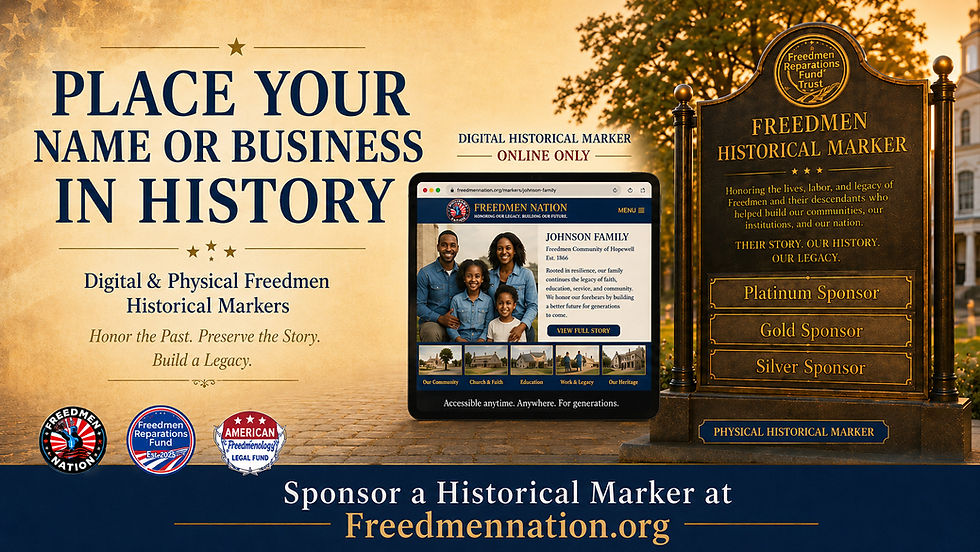
Sponsor a Freedmen Historical Marker
Supporters may also sponsor a Freedmen Historical Marker. A sponsored marker can help identify, honor, and preserve the history of Freedmen families, communities, churches, cemeteries, schools, businesses, land settlements, and other sites connected to our people’s legacy.
Marker sponsorship supports public memory while strengthening the record of where our families lived, worked, built Institutions, and passed land and history to their Successors. It helps establish a lasting presence for future generations.


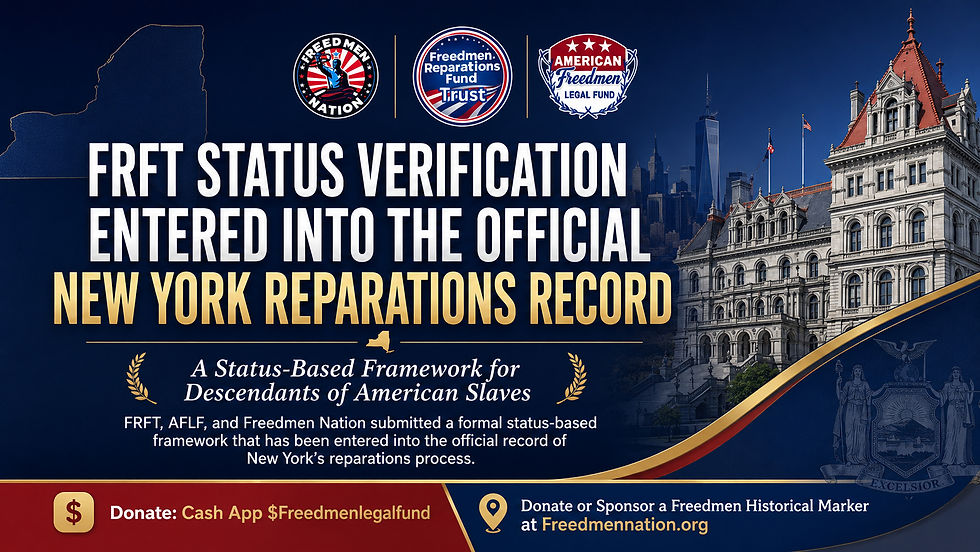
The Freedmen Nation FRFT is not only Showing-Up for Freedmen Heirs, but with this important 14th amendment Freedmen mothion, FRFT is Showing-Out.
"We Never Stopped"
AW, Jr. -2025