
5,000 Status Verified Freedmen Successors: Building the Record to Question Ancestry.com


Freedmen Nation | Freedmen Reparations Fund Trust
We are the successors of Freedmen. Our institutional work begins with documented lineage, historical records, and continuity between generations.
The concern prompting this initiative includes reports we are seeing on social media: people say they have used U.S. federal, state, and county records available through Ancestry.com to document their family ancestry, yet their AncestryDNA maps assign ancestry to regions where their documented family trees identify no ancestors—including regions in Africa.
These reports deserve examination of the underlying documents, complete DNA results, and explanations provided to customers.
The comparison concerns named ancestors supported by records and geographic assignments produced by a commercial DNA service. Participants are asking how the company connects those two kinds of information, what supports the assigned regions, and what those assignments establish about their particular families.
For example, a customer might document several generations in Mississippi, Alabama, and Tennessee through census, birth, death, marriage, and probate records, while receiving DNA assignments to regions in Africa without locating a named ancestor from those regions. This illustrative case presents a question for investigation: What does the genetic assignment mean, and what evidence supports that interpretation for this customer?
A DNA region is an estimate based on genetic comparison with reference populations; it does not itself identify a named ancestor in a historical record. Likewise, an absence of documented ancestors in a region does not establish that no earlier ancestors came from there. Our inquiry concerns the accuracy of the assignments, the limits of the records, and whether customers receive a clear explanation of the relationship between them. (help.ancestry.com)
Freedmen Nation is calling for 5,000 Status Verified Freedmen Successors to strengthen a documented population and gather evidence for independent scientific and legal review. Our objective includes evaluating whether complaints against Ancestry.com support a viable class action or other appropriate remedy.
Status verification and complaint documentation serve distinct purposes. Verification establishes a participant’s documented connection to the population our institution serves. A complaint establishes what that person experienced as a customer, what they dispute, and what supporting evidence exists.
Our principle is status, not race. Freedmen Nation’s verification process evaluates genealogy and historical records, including census continuity, vital records, Freedmen’s Bureau materials, and probate documents. It determines status within the Trust; it does not depend on a commercial DNA percentage or confer government recognition.
A population of 5,000 verified Successors would give this initiative a broader documentary foundation. With participants’ permission, records could be organized by family, location, generation, product version, and type of complaint. That would help reviewers distinguish recurring problems from isolated misunderstandings. Its size alone would not make it a representative genetic reference panel.
The research raises additional questions about population selection and Indigenous ancestry.
Bryc et al. (2015) studied 5,269 self-described African American customers of 23andMe. Their group classification relied on self-identification, while ancestry estimates relied on DNA data. The study included Native American ancestry estimates. Its published recruitment method did not establish a cohort through verified Freedmen genealogy. (pmc.ncbi.nlm.nih.gov)
Findings about a broadly self-identified population do not automatically establish accuracy for a separately defined population of documented Freedmen Successors. We are asking what validation supports applying such findings to our families, including families with documented Indigenous ancestry.
Ancestry’s 2026 white paper describes African American evaluation simulations using a method similar to Mooney et al. (2023). It also describes using aggregated family trees elsewhere in its methodology. The question is how adequately documented Freedmen histories are represented in its validation. (ancestrycdn.com)
Mooney’s African American model considered African and European sources and explicitly excluded Native American and other sources. Its limitations section cites Bryc and Baharian in explaining that decision. The authors acknowledge that including Native American ancestry would replace some modeled African and European ancestors. (rosenberglab.stanford.edu)
That is a documented limitation worth examining. It does not establish that Ancestry adopted every assumption in Mooney’s model. Ancestry should explain whether its adapted simulations include Indigenous ancestry and how they test accuracy for families whose histories extend beyond that two-source framework.
Our concern is whether some assignments overstate particular ancestry components or fail to reflect detectable Indigenous ancestry. Establishing that requires individual evidence and independent analysis; neither Bryc’s recruitment method nor Mooney’s modeling limitation alone proves a customer’s percentages are wrong.
Ancestry also discloses that it filters certain low-probability assignments and redistributes the remainder among reported regions so percentages total 100%. Corresponding chromosome-painter windows can remain “Unassigned.” Customers should be able to understand how much of their report is affected and how that redistribution changes the figures they see. (ancestrycdn.com)
The following examples illustrate the evidence participants should document:
Documented U.S. family history and a DNA map appear disconnected. A customer may have a family tree supported by federal, state, and county records but no documented connection to one or more regions on the DNA map, including regions in Africa. The complaint should identify the earliest supported ancestor on each researched branch, dates and places, gaps in the record, the assigned DNA regions, and the explanation requested. A historical record hosted on Ancestry should be distinguished from a relationship entered by a user or an automated hint.
A documented Indigenous ancestor is absent from a regional estimate. A family might possess records identifying an ancestor as Indigenous and records linking that person to later generations. Those documents deserve genealogical review. Because a distant ancestor may leave no detectable autosomal DNA, reviewers must examine both the lineage evidence and the genetic detection limits. (pmc.ncbi.nlm.nih.gov)
A regional estimate changes after an update. A customer might receive an Indigenous regional estimate in one version and no such estimate in the next. Useful evidence includes dated reports, confidence ranges, the company’s explanation, and the representations made when the customer purchased the service.
Parent and grandparent displays appear inconsistent. One submitted video shows 16% paternal and 11% maternal contributions totaling 27%, while four displayed grandparent contributions total 16%. Ancestry explains that grandparent assignments can be incomplete. A meaningful complaint should include the complete display and any unassigned portions so reviewers can determine whether the gap is explained, poorly communicated, or erroneous. (help.ancestry.com)
A complaint becomes more useful when it identifies the disputed result, the evidence supporting the concern, and the response requested.
Freedmen Nation seeks answers to five questions:
How should customers reconcile documented U.S. family histories with assigned DNA regions for which they have located no ancestral records, including regions in Africa?
How were documented Freedmen Successors represented in validation?
Did the African American simulations include Indigenous ancestry?
What are the relevant error rates and detection limits for the regional assignments being disputed?
How can customers obtain a meaningful explanation of changes and redistributed assignments in their own reports?
The 5,000-person target is our organizing goal. Federal Rule of Civil Procedure 23 does not establish a 5,000-person requirement. Class certification requires several separate findings, including common questions and adequate representation; verification alone does not establish a viable claim. (uscourts.gov)
Ancestry’s current U.S. terms include arbitration provisions and a class action waiver. Counsel would need to assess the applicable agreements, enforceability, alleged misconduct, individual injury, and available remedies before determining a litigation strategy. (ancestry.com)
FRFT and the American Freedmen Legal Fund provide institutional documentation, advocacy, referral, and attorney coordination. Neither is a law firm. Submitting a complaint does not create an attorney-client relationship or file a lawsuit.
Get Status Verified, then submit your documented complaint.
Begin at Start Verification. Complete Step #1, then follow Step #2 to submit the required genealogical documentation.
Once approved, if you have a complaint about your own experience with Ancestry, use your Freedmen Nation ID when completing our complaint form.
Identify Ancestry.com in your complaint and provide:
What you purchased, when you purchased it, and the relevant receipt.
The specific statement, result, or update you dispute.
Dated screenshots and available confidence ranges.
Federal, state, and county records supporting your family tree, with names, dates, places, and archive citations.
The earliest documented ancestor on each relevant branch, any gaps, and the DNA regions for which you have located no documentary connection.
Correspondence with Ancestry and its response.
Any financial loss or other concrete consequence, with supporting evidence.
Describe your experience accurately. Participation should help establish what happened, including evidence that may explain or resolve a concern. Keep original records and copies of everything submitted.
Support This Work Through Donations
Documenting complaints, obtaining records, reviewing family histories, maintaining research tools, and coordinating independent review require sustained resources. Donations support the institution’s capacity to perform this work. AFLF’s published funding purposes include complaint letters, public education, records requests, and documentation for potential litigation.
A contribution can help support the practical work behind accountability: locating an archive record, organizing a family’s evidence, or preparing a documented institutional inquiry.

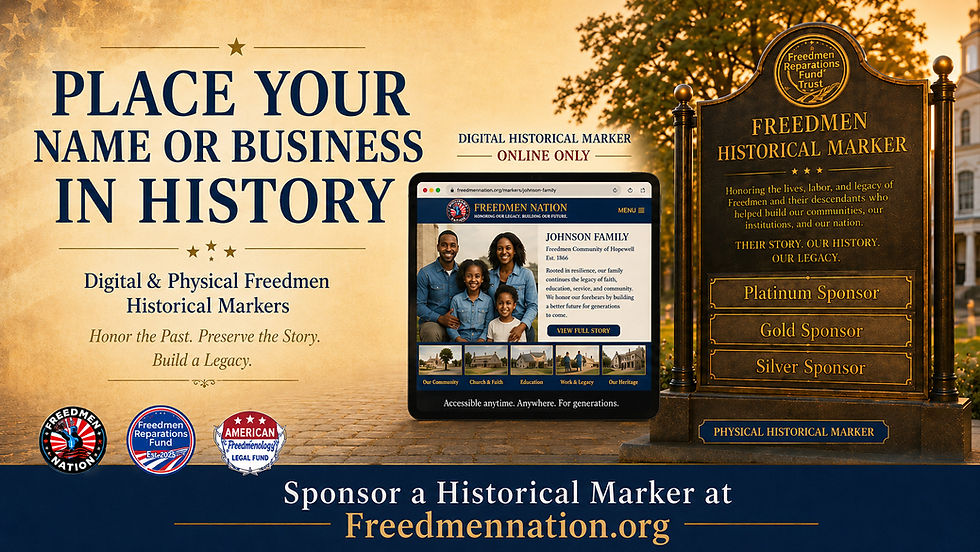
Sponsor a Freedmen Historical Marker
Historical preservation supports the same commitment to documented identity. Freedmen Historical Markers help preserve the histories of individuals, families, churches, cemeteries, and communities. Sponsorship supports research, documentation, and preservation work associated with the applicable marker program.
For example, a family may seek recognition of a documented ancestor, a church may preserve its founding history, or a business may support a community heritage site. Each project should rest on an accurate historical record and the program’s review process.



We’ll get there soon