
Freedmen in the Supreme Court Record: An 1872 Case and Its Meaning Today


In Blyew v. United States, Justice Joseph Bradley used the term while explaining why emancipation required more than the formal abolition of slavery.
His 1872 dissent, joined by Justice Noah Swayne, described the need:
“to instate the freedmen in the full enjoyment of that civil liberty and equality which the abolition of slavery meant.”
Those words appear on page 601 of the official court report. They connect freedmen directly to emancipation, civil liberty, and equality.

The Case Behind the Words
Blyew v. United States arose from the murder of Lucy Armstrong in Kentucky. Two white defendants, John Blyew and George Kennard, were prosecuted and convicted in federal court.
Kentucky’s discriminatory witness restrictions prevented Black witnesses from testifying against white defendants in state court. Federal prosecutors relied on the Civil Rights Act of 1866 to bring the prosecution into federal court.
The Supreme Court ruled that the federal court lacked jurisdiction under the statute. Its narrow interpretation excluded the witnesses and deceased victim from the persons “affected” in the sense required to establish jurisdiction.
Bradley and Swayne disagreed.
Freedom Required Access to Justice
The dissent identified the consequences of denying an entire class of people the ability to give evidence against those who harmed them: their lives, families, and property could be left without effective legal protection.
Bradley argued that abolishing slavery required addressing the disabilities and consequences it had produced. A person’s freedom had little security if the legal system refused to hear the evidence necessary to protect that person.
This language came from the dissent, not the majority ruling. Its value must be presented accurately: it records a powerful judicial argument about the meaning of emancipation, rather than a binding holding adopting that argument in this case.
Why This Matters for Freedmen Today
For Freedmen Nation and the Freedmen Reparations Fund Trust, this record provides a documented historical reference for institutional education and outreach.
It demonstrates that “freedmen” was used in nineteenth-century Supreme Court writing when discussing the people emerging from slavery and the rights necessary to make their freedom meaningful.
That history belongs in conversations with museums, universities, public agencies, and communities researching their ancestors. It gives us a precise source to cite when explaining the historical foundations of the terminology we use.
The case does not establish FRFT’s verification authority, create a modern federal classification for descendants, or automatically grant benefits. Its contribution is historical evidence and legal reasoning that can be studied and accurately cited.
Connecting History to Present-Day Protection
Later decisions provide stronger authority for specific legal claims.
In Jones v. Alfred H. Mayer Co. (1968), the Supreme Court upheld Congress’s authority to prohibit private racial discrimination in property transactions under the Thirteenth Amendment’s enforcement power. The decision addressed Congress’s ability to legislate against the badges and incidents of slavery.
Today, federal statutes including 42 U.S.C. §1981 and §1982 protect equal contractual and property rights. Their protections are not limited to people with verified Freedmen ancestry.
For our advocacy, the practical work is to connect documented harm to an applicable legal protection: identify the injured person, preserve the records, establish what happened, and identify the remedy being sought.
Historical records explain the struggle. Present-day evidence helps establish the claim. Both deserve careful institutional attention.
Support Our Research and Advocacy
Preserving records, examining historical cases, and documenting present-day grievances require time and resources.
Support Freedmen Nation, FRFT, and the American Freedmen Legal Fund’s research, documentation, and advocacy.

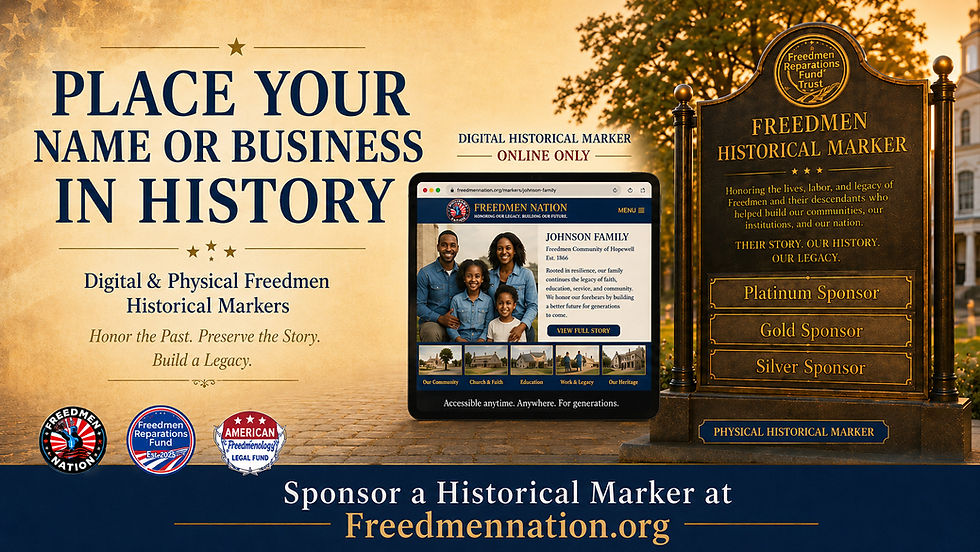
Sponsor a Freedmen Historical Marker
Freedmen history deserves a permanent place in the public landscape. Our historical marker initiative helps preserve the stories of Freedmen communities, cemeteries, ancestors, and institutions for future generations.
Court records preserve one part of that history. Historical markers help connect those records to the places where people lived, worked, built communities, and were laid to rest.
We invite individuals, families, businesses, churches, and community organizations to support this work through donations or marker sponsorships.
Help make this history visible where it happened.

Sources
Blyew v. United States, 80 U.S. (13 Wall.) 581, 601 (1872), Bradley, J., dissenting. The quoted passage appears on PDF page 21: https://tile.loc.gov/storage-services/service/ll/usrep/usrep080/usrep080581/usrep080581.pdf
Jones v. Alfred H. Mayer Co., 392 U.S. 409 (1968): https://supreme.justia.com/cases/federal/us/392/409/
42 U.S.C. §1981—Equal rights under the law:
42 U.S.C. §1982—Property rights of citizens:


SCJ Bradley & Swayne's Dissent was totally ignored since 1871, and it's time for the FRFT to demand Congressional Apporiations under the Emancipation Proclamtion. He said it himself the admendment was not an executive order, it was the LAW of the land