
The Freedmen Origins of Memorial Day: How the First Decoration Day Began in Charleston


Memorial Day is now recognized across the United States as a national day of remembrance for those who died while serving in the military. Many people mark the day with flags, cemetery visits, public ceremonies, and family gatherings. But before Memorial Day became a federal holiday, it began as a sacred act of remembrance after the Civil War.
One of the earliest and most powerful origins of Memorial Day comes from Charleston, South Carolina, where newly freed slaves gathered on May 1, 1865, to honor Union soldiers who had died while imprisoned by the Confederacy.
This historic event took place at the former Washington Race Course and Jockey Club, now known as Hampton Park. A historical marker at the site recognizes this ceremony as one of the earliest Memorial Day observances in the country.
Historical Marker Location
“First Memorial Day” Historical Marker
Hampton Park
30 Mary Murray Drive
Charleston, South Carolina 29403
This is the same historic site where Freedmen honored the Union soldiers buried at the former race course cemetery known as “Martyrs of the Race Course.”
During the Civil War, the Washington Race Course was used as a prison camp for captured Union soldiers. More than 250 Union prisoners died there and were buried in mass graves before Charleston fell in 1865.
After the Confederacy evacuated the city, Freedmen, ministers, teachers, and community leaders helped recover the bodies of the fallen Union soldiers. They reburied them with dignity, built a fence around the burial ground, and marked the entrance with the words:
“Martyrs of the Race Course.”
On May 1, 1865, thousands of Freedmen gathered at the cemetery to honor those soldiers. Freedmen schoolchildren led the procession with flowers. Ministers, community members, Union supporters, and soldiers followed behind them. The graves were decorated, songs were sung, prayers were offered, and the fallen were publicly remembered.
This was not simply a ceremony. It was an act of historical correction.
The Freedmen turned a site of imprisonment and death into a place of honor. They took soldiers who had been left in mass graves and restored dignity to their memory. They made sure the men who died in service to the Union would not be forgotten.
This is why the Charleston origin of Memorial Day matters.
Before the holiday became nationalized, Freedmen had already shown the country what remembrance should look like. They honored the dead. They protected the burial ground. They gathered as a community to mark the sacrifice of those who died in the war that ended slavery and preserved the Union.
The national holiday developed later. In 1868, the Grand Army of the Republic formally established Decoration Day, and the first national observance took place at Arlington National Cemetery. Over time, Decoration Day became Memorial Day. After World War I, the observance expanded to honor military service members who died in all American wars. In 1971, Memorial Day became a federal holiday observed on the last Monday in May.
But the foundation had already been laid in Charleston.
The cemetery at the former Washington Race Course, remembered through the words “Martyrs of the Race Course,” should be treated as sacred American ground. It represents sacrifice, dignity, memory, and the direct role Freedmen played in shaping national remembrance.
Freedmen were not passive observers of history. They were builders of memory. They understood the cost of freedom and the importance of honoring those who died in defense of it.
Memorial Day should therefore be remembered not only as a military holiday, but also as a Freedmen historical marker. Its earliest meaning was shaped by burial, flowers, prayer, schoolchildren, community leadership, and a people newly freed who understood that memory must be protected.
Before Memorial Day became commercialized, Freedmen gave it meaning.
They honored the fallen.
They protected the graves.
They decorated the cemetery.
They created a public act of remembrance that the nation later adopted.
So when Memorial Day is observed, we should remember the service members who died in uniform. But we should also remember the Freedmen of Charleston who first showed America how to honor them.
Support Freedmen Historical Preservation
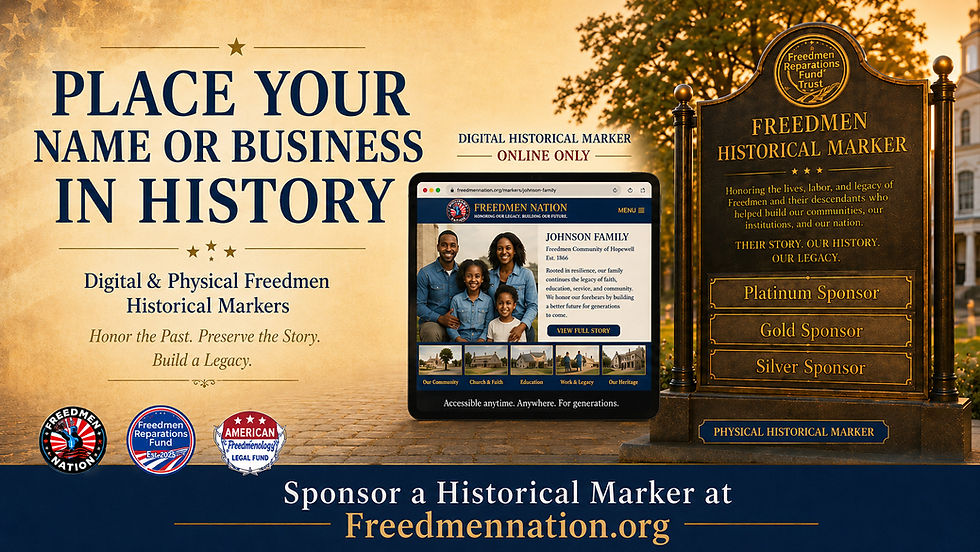
The Freedmen Reparations Fund Trust is working to protect, preserve, and publicly identify Freedmen historical sites, cemeteries, burial grounds, churches, schools, family land, and community landmarks through the Freedmen Historical Marker Program.
Our goal is to make sure Freedmen history is not erased, misclassified, or left unprotected. Historical markers help document the truth, identify sacred sites, educate the public, and create a permanent record for future generations.
Supporters can help by donating to our preservation work or by becoming a Freedmen Historical Marker Sponsor. Sponsorship helps support the research, documentation, marker creation, public reporting, and ongoing preservation work connected to Freedmen historical sites.
To support this work:
Or
And
Your support helps us protect the places, names, records, and sacred grounds connected to Freedmen history.


Some Powerful & Impactful Freedmen Nation History, Arthur...Thank you.