
National Banks Were Offered a Path to Preserve Freedmen History. Most Chose Not to Act.

Updated: Sep 4
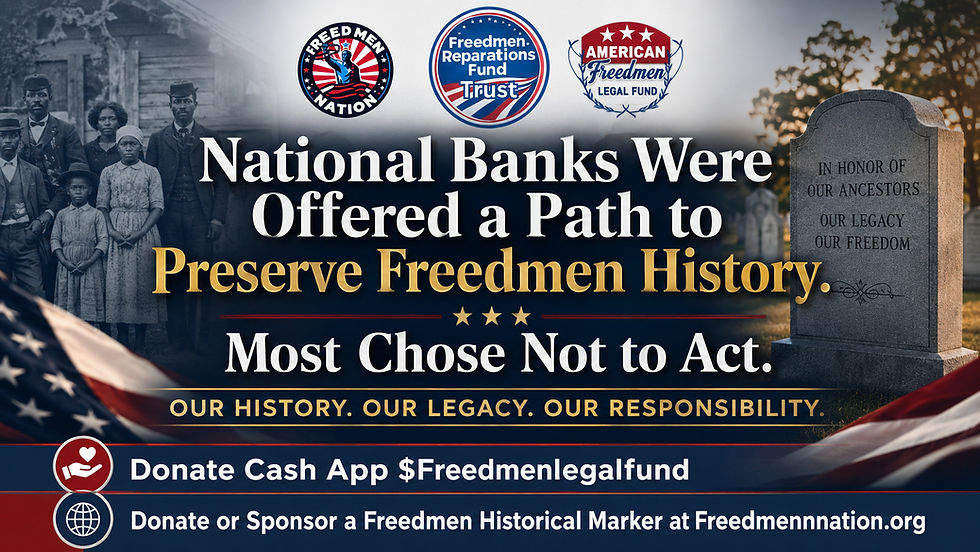
The Freedmen Reparations Fund Trust has been working to bring national banks into the FRFT Freedmen Historical Marker Program, not as a general grant request, but as a direct sponsorship opportunity tied to preservation, education, public memory, and historical responsibility.
These banks were not asked to guess what to do. They were given a clear path.
They were presented with multiple sponsorship options, including a National Founding Preservation Sponsorship, Regional Preservation Sponsorship, Anchor Marker Sponsorship, Physical Marker Sponsorship, and a Digital Freedmen Historical Marker option beginning at $500. The structure was designed so that a bank did not have to say “yes” to everything in order to say “yes” to something.
They could have helped preserve a cemetery.
They could have helped mark a Freedmen church, school, settlement, land site, civil rights leader, or historical landmark.
They could have supported a digital marker.
They could have helped create a QR-linked historical record.
They could have helped protect the resting places of the people whose labor helped build this country.
Most decided not to choose any option.
This Is Bigger Than One Sponsorship Request
The history of banking in the United States cannot be separated from slavery, land, labor, credit, property, and exclusion.
Historians have documented that nineteenth-century banks accepted enslaved people as mortgage collateral, and that foreclosure proceedings could result in enslaved people being seized and sold. In other words, banks did not simply exist near slavery.
The financial system helped assign value to enslaved human beings and used that value to support credit, debt, property transfer, and wealth production. (GW Today)
Congressional financial-services records also describe historical banking and financial practices tied to slavery, including lending capital for the purchase of enslaved people, accepting enslaved people as collateral, taking ownership after default, and issuing insurance policies connected to enslaved persons. (House Financial Services Dems)
That history matters because it shows how the enslaved were treated as assets in life, but too often are treated as extinguished in death.
That is the contradiction FRFT is confronting.
When financial institutions could extract value from the enslaved, the system knew how to count them. But when Freedmen cemeteries need maintenance, protection, markers, research, fencing, documentation, and peaceful preservation, too many institutions act as though there is no continuing obligation to remember them.
FRFT rejects that.
The people were not extinguished when they died.
Their successors remain.
Their burial grounds remain.
Their churches remain.
Their schools remain.
Their settlements remain.
Their land records remain.
Their civil rights history remains.
Their contributions to the United States remain.
From Slavery to Jim Crow to Financial Exclusion
After emancipation, Freedmen were forced to build families, communities, churches, schools, businesses, farms, cemeteries, and civic institutions inside a hostile economic system. Slavery ended, but exclusion did not.
Jim Crow and later discriminatory financial practices continued to shape who could obtain credit, buy property, protect land, build wealth, and maintain community institutions. The Federal Reserve’s history materials describe redlining as the denial of access to credit based on where people lived, with Freedmen neighborhoods especially affected; the Fair Housing Act of 1968 outlawed racially motivated redlining. (Federal Reserve History)
The Community Reinvestment Act of 1977 later required federal banking agencies to evaluate whether banks were meeting the credit needs of their entire communities, including low- and moderate-income neighborhoods. (OCC.gov)
That history is connected to preservation today.
When Freedmen cemeteries are abandoned, disturbed, eroded, paved over, fenced off, misclassified, or left without maintenance, it is not only a cemetery problem. It is part of a larger failure to preserve the people and communities who survived slavery, built after emancipation, endured Jim Crow, and still remain under-recognized in the national record.
FRFT’s position is simple:
Freedmen history is United States history.
It is not a side story.
It is not a local footnote.
It is not a charity category.
It is not something that disappears when a funding committee says no.
What the Banks Were Offered
FRFT gave national banks multiple ways to participate.
They were offered sponsorship options that could support physical markers, anchor markers, digital markers, QR-linked history pages, cemetery preservation, historical research, genealogy, tourism, education, and long-term maintenance planning.
The options included:
National Founding Preservation Sponsorship
A major sponsorship supporting a multi-state preservation portfolio.
Regional Preservation Sponsorship
A sponsorship supporting county or regional clusters of cemeteries, landmarks, Famous Freedmen, settlements, churches, schools, and land sites.
Anchor Marker Sponsorship
A sponsorship supporting a destination-level marker project.
Physical Marker Sponsorship
A sponsorship supporting a qualifying physical historical marker.
Digital Freedmen Historical Marker Sponsorship
A lower-entry option beginning at $500 to support digital preservation, public-history writing, archival preparation, QR-linked history, and permanent online recognition.
The banks had room to choose.
They could have chosen a major role.
They could have chosen a regional role.
They could have chosen one physical marker.
They could have chosen one digital marker.
Most chose none.

Wells Fargo Took a Different Step
FRFT does want to acknowledge Wells Fargo for at least placing the sponsorship request into a formal review path.
After outreach, Wells Fargo directed FRFT to its sponsorship portal, and FRFT submitted the National Founding Preservation Sponsorship proposal through that process. That does not mean Wells Fargo has approved the request. It means the proposal was not dismissed only through email and was moved into a formal sponsorship-review channel.
That matters.
At a minimum, Wells Fargo allowed the proposal to be considered through a structured process. FRFT will continue to monitor that review and hopes Wells Fargo will recognize the national importance of preserving Freedmen cemeteries, Historical Landmarks, Famous Freedmen Historical Markers, settlements, churches, schools, land sites, and community institutions.
Sponsor a Freedmen Historical Marker
FRFT is not waiting for banks to decide whether Freedmen history is worth preserving.
Businesses, families, artists, churches, institutions, and community supporters can sponsor a Freedmen Historical Marker directly.
A sponsorship can help preserve:
Freedmen cemeteries and burial grounds
Freedmen Historical Landmarks
Famous Freedmen Historical Markers
Civil rights leaders
Churches and schools
Settlements and freedom communities
Land sites and family properties
Businesses and community institutions
QR-linked digital histories
Heritage-tourism routes
Public education and genealogy records
Every qualifying Physical or Anchor Freedmen Historical Marker sponsorship receives Platinum Sponsor recognition on the applicable marker. Digital sponsorships provide a lower-entry way to support historical research, narrative development, archival preparation, online publication, and public access.
Donation and Preservation Support
FRFT’s preservation work includes research, documentation, cemetery review, historical-marker development, digital preservation, public-history writing, genealogy, community coordination, and long-term maintenance planning.
Support helps FRFT continue identifying endangered Freedmen cemeteries, documenting historical sites, building marker pages, preparing preservation records, and protecting the public memory of Freedmen communities across the United States.
Every contribution helps move the work forward.

FRFT Will Continue
National banks were given a chance to help preserve Freedmen history through a direct, visible, measurable sponsorship model. Most declined, redirected, or chose not to participate.
But FRFT is not stopping.
We are documenting the record.
We are building the marker program.
We are identifying cemeteries.
We are working with counties.
We are creating preservation pathways in Texas, Florida, Kentucky, Virginia, Georgia, Tennessee, and beyond.
We are building a national system so the history can no longer be hidden, ignored, or left to decay.
Freedmen cemeteries are not dead land.
Freedmen churches are not forgotten buildings.
Freedmen schools are not footnotes.
Freedmen settlements are not empty places.
Famous Freedmen, civil rights leaders, landowners, veterans, pastors, teachers, entrepreneurs, and community builders are not erased because banks refuse to participate.
If the financial system once knew how to count the enslaved as value, then modern institutions should know how to help preserve their resting places, descendants, records, landmarks, and public memory.
The Freedmen Reparations Fund Trust is here to protect that history.
Marker by marker.
Cemetery by cemetery.
Landmark by landmark.
Generation by generation.


So what I would do is purchase dividend earning stock in (their parent) company then use part of their payouts to fund historical markers. I’d also investigate their financial links to slavery/other horrors as all bankers do.
All contracts that cause companies to pay inidividuals or organizations via securities -is a form of corporate reparations -to me.
Sen. Tim Scott(SC) Senate Banking Committee Chairman, Bring This Matter To His Attention.