
How the Freedmen Reparations Fund Trust (FRFT) Can Work With Non-Profits
- Freedmen Nation
- Feb 11
- 3 min read

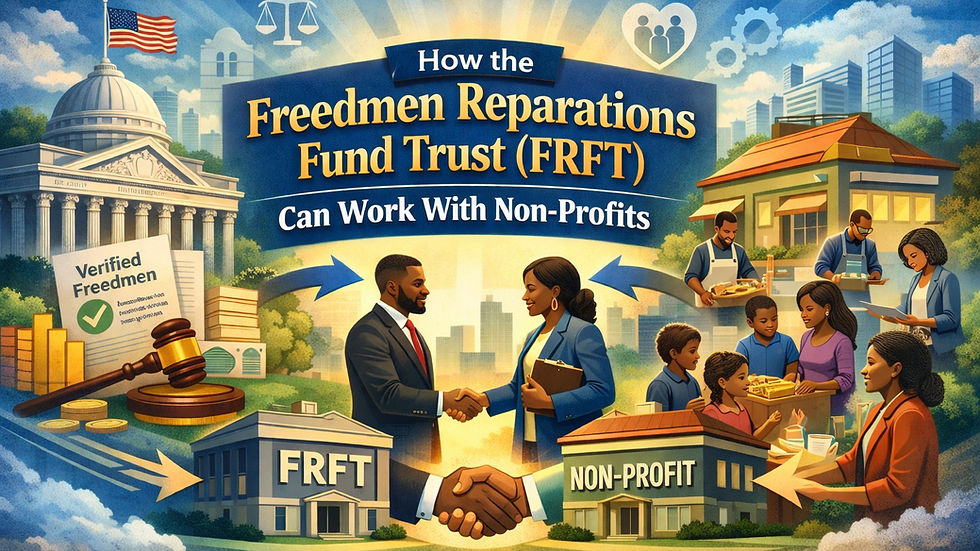
The Freedmen Reparations Fund Trust (FRFT) is no longer simply an organizing framework. It is an Institution.
As a private, irrevocable trust with federal acknowledgment and formal governance structure, FRFT now operates as a recognized institutional authority over status-protected reparative frameworks for Freedmen in the United States. This shift changes how non-profits can interact with, align with, and benefit from structured reparative governance.
Non-profits do not need to become FRFT.
They can work with FRFT.
The difference matters.
Understanding the Institutional Distinction
FRFT is not a charity. It does not operate under nonprofit law. It is a private trust institution with fiduciary duties to its Beneficiaries and a defined governance structure.
Non-profits, by contrast, are public-facing charitable entities regulated under state and federal nonprofit statutes.
This distinction creates opportunity — not conflict.
Because FRFT is not competing for nonprofit status, it can:
Provide structural clarity
Offer governance alignment
Protect status-based identity frameworks
Serve as an institutional anchor for reparative initiatives
Non-profits remain free to fundraise, administer programs, and serve communities — while aligning with a recognized institutional body that defines and protects Freedmen status.
Why Non-Profits Should Consider Alignment
Many organizations serving Freedmen communities have historically operated under broad racial classifications. That structure often results in:
Funding dilution
Program misclassification
Identity confusion
Loss of specificity in reparative claims
FRFT provides a status-based framework — not a racial label — that clarifies who reparative efforts are designed to serve.
For non-profits, this means:
Clearer grant positioning
Stronger program justification
Institutional legitimacy in reparations discussions
Protection from mission drift
Alignment does not mean surrendering autonomy. It means strengthening structural clarity.
What Collaboration Can Look Like
FRFT can work with non-profits in structured, mutually respectful ways:
1. Status Verification Guidance
Non-profits serving Freedmen populations can refer individuals to FRFT’s verification system to ensure program integrity. This prevents misclassification while protecting nonprofit credibility.
2. Joint Programming
Non-profits may design educational, economic, cultural, or legal programs aligned with FRFT’s governance framework — without transferring control of their organization.
3. Institutional Support in Advocacy
When engaging policymakers, municipalities, or philanthropic institutions, nonprofits aligned with FRFT can point to a recognized institutional structure supporting their mission. That leverage matters in policy discussions.
4. Protection of Intellectual and Cultural Frameworks
FRFT maintains declarations and structured protections over its institutional language and status frameworks. Non-profits that align avoid unintentionally using protected language improperly and instead operate in coordinated compliance.
What FRFT Does Not Do
To be clear:
FRFT does not absorb nonprofits.
FRFT does not control nonprofit boards.
FRFT does not convert nonprofits into private trusts.
FRFT does not distribute funds as a charitable grantmaker.
FRFT operates as a fiduciary institution serving its Beneficiaries and protecting status-based reparative structure.
Non-profits operate as public charitable organizations.
The collaboration is structural — not hierarchical.
The Institutional Advantage
The greatest benefit to nonprofits is this:
They no longer have to argue for legitimacy alone.
An Institution now exists that:
Defines status protection
Maintains governance structure
Holds federal acknowledgment
Operates with fiduciary clarity
Non-profits can continue their mission work while operating alongside an established institutional anchor.
This reduces fragmentation in reparative efforts and increases collective strength.
Moving Forward
Reparations infrastructure cannot be built through isolated organizations operating without structural alignment. It requires:
Legal clarity
Status protection
Institutional governance
Coordinated effort
FRFT is now positioned to provide that institutional foundation.
Non-profits that are serious about serving Freedmen communities can explore structured alignment — not as subordinates, but as strategic partners.
The future of reparative work will not be built on slogans.
It will be built on Institutions working together.


Comments