
From Jurisdiction to Continuation: How the Freedman’s Bank Federal Record Benefits Verified Freedmen


On August 26, 2026, the Freedmen Reparations Fund Trust (FRFT) received an official response from the Office of the Comptroller of the Currency concerning the Freedman’s Savings and Trust Company, commonly known as the Freedman’s Bank.
The response did not decide the historical issues raised by FRFT. It did not reject the concept of Verified Freedmen successors. It did not determine that FRFT’s proposed consultation framework lacked merit.
Instead, the OCC informed FRFT that the matter presented was outside the banking-law jurisdiction of its Customer Assistance Group.
That distinction is important.
For FRFT, this is not the end of the administrative process. It helps identify the next jurisdictional path while strengthening an increasingly important federal record concerning the Freedman’s Bank, its depositors, their families, and the successor community that exists today.
The Original FRFT Filing
On July 6, 2026, FRFT issued a Supplemental Administrative Notice and Request to the U.S. Department of the Treasury, Office of the Comptroller of the Currency, National Archives and Records Administration, relevant congressional offices, and other federal record custodians.
The filing requested administrative recognition, consultation, preservation of records, and a federal conference concerning the Freedman’s Bank legacy and Verified Freedmen successor interests.
Importantly, FRFT did not claim that it presently owned the former bank, federal buildings, or federal archival records.
The Notice expressly stated that FRFT was requesting recognition of an institutional role involving consultation, record stewardship, public legacy use, and possible future federal reparative programs connected to the Freedman’s Bank legacy.
That distinction protected the institutional position from being reduced to an unsupported ownership claim.
Why the Freedman’s Bank Matters
The Freedman’s Savings and Trust Company was created in 1865 for formerly enslaved people and their families.
Its surviving records contain extraordinary genealogical information, including family relationships, occupations, birthplaces, spouses, children, parents, siblings, and other identifying information.
FRFT’s July filing emphasized that these records connect Freedmen families directly to the post-emancipation historical record.
That creates an important distinction between general historical interest and documented successor-community interest.
FRFT’s position is that the people connected to these records should not disappear from the modern institutional discussion surrounding the Freedman’s Bank.
What the OCC Response Actually Means
The OCC’s Customer Assistance Group handles complaints involving national banks and federal savings associations and evaluates matters through banking statutes, regulations, and supervisory policies.
The OCC determined that the issue FRFT presented was outside that banking-law jurisdiction.
That is a jurisdictional determination.
It is not the same thing as a ruling on whether Verified Freedmen constitute a successor community.
It is not a ruling against FRFT’s status-verification system.
It is not a ruling against depositor-successor research.
And it is not a determination that Congress, Treasury, NARA, or another federal entity cannot consider the broader historical, archival, consultative, or reparative questions raised by FRFT.
The distinction between “we disagree with your position” and “this matter is outside our jurisdiction” is substantial.
Benefit No. 1: FRFT Has Created a Federal Administrative Record
One of the most immediate benefits is documentation.
The federal government now has correspondence identifying:
The Freedmen Reparations Fund Trust;
The Freedman’s Savings and Trust Company;
Verified Freedmen successor interests;
Depositor-successor research;
Federal consultation;
Historical record preservation; and
The question of future legislative consideration.
The original Notice expressly asked federal agencies to preserve this issue in their administrative records.
The OCC response demonstrates that the submission entered an actual federal administrative process and received a federal case number.
That does not constitute federal approval of FRFT.
It does establish a documented chronology.
And institutional chronology matters.
Benefit No. 2: We Now Know One Jurisdiction That Does Not Fit
Administrative advocacy frequently requires identifying which agency has authority over which portion of an issue.
The OCC has now clarified that its consumer-banking jurisdiction is not the appropriate mechanism for resolving the broader questions presented.
That information has practical value.
FRFT does not need to repeatedly pursue the same issue through an office that has already said the subject exceeds its banking-law jurisdiction.
Instead, the Trust can continue the unresolved portions through Treasury, NARA, congressional offices, archival authorities, and other appropriate channels.
Knowing where jurisdiction does not exist helps identify where authority may exist.
Benefit No. 3: FRFT Anticipated the Jurisdictional Problem
One of the strongest aspects of the July Notice is that FRFT had already anticipated that no single administrative agency might possess authority to resolve every part of the Freedman’s Bank legacy.
The proposed consultation framework specifically stated that it was designed so that no federal agency would have to exceed its authority while preserving the record for potential later congressional action.
The Notice also requested congressional consideration of a possible modern restorative framework, including:
An advisory commission;
A legacy fund; or
A Verified Freedmen successor registry connected to depositors and heirs.
The OCC jurisdictional response therefore does not destroy the strategy.
It demonstrates why the multi-agency and legislative strategy was necessary in the first place.
Benefit No. 4: “Successor” Is Already Part of the Institutional Record
The July filing predates the current public discussion concerning whether Freedmen status can continue through succeeding generations.
FRFT had already incorporated successor terminology into its institutional framework.
The Notice contains an entire section titled:
“Status-Based Verification and Successor Standing.”
That section explains FRFT’s position that a modern interpretation of the Freedman’s Bank legacy requires a method for identifying the successor community through records rather than broad racial identification, commercial ancestry claims, or DNA-based assertions.
This is significant because FRFT is not suddenly adopting the word “successor” in response to a social-media debate.
The terminology already existed within an administrative filing transmitted to federal institutions.
FRFT can now strengthen that framework internally by formally defining Freedmen Successor within its Trust governance documents.
Benefit No. 5: The Record Separates Verification From Self-Identification
FRFT’s position has consistently emphasized documentation.
The July Notice states that the relevant question is not simply whether someone identifies with a particular history.
The relevant question is whether that individual can be connected through recognized records to the Freedmen status community.
That distinction is fundamental to the Trust’s verification model.
A Verified Freedmen status determination is intended to be based upon documented lineage and institutional verification—not merely personal declaration.
For FRFT, verification creates an administratively governed relationship between the historical record and the present successor community.
Benefit No. 6: The Next Federal Filing Is Stronger
FRFT can now continue the matter with a clearer jurisdictional record.
The next federal communication can accurately state:
FRFT presented the matter to the OCC; OCC determined that the issues presented fall outside its banking-law jurisdiction; FRFT is therefore continuing the unresolved archival, consultation, preservation, and legislative components through the federal entities possessing the appropriate authority.
That is substantially stronger than simply sending another request without explaining what has already occurred.
It demonstrates persistence while respecting agency jurisdiction.
What FRFT Should Not Claim
Institutional credibility requires precision.
FRFT should not say:
“The OCC recognized Verified Freedmen.”
“The OCC approved FRFT.”
“The federal government recognized FRFT as the successor to the Freedman’s Bank.”
“OCC confirmed that Freedmen status is inheritable.”
“OCC awarded FRFT standing.”
None of those conclusions appears in the response.
In fact, FRFT’s own July filing specifically stated that the Notice should not be interpreted as asserting that Treasury or OCC had already approved FRFT’s position.
That limitation remains important.
What FRFT can accurately say is that it placed the Verified Freedmen successor-community issue before federal institutions, that OCC processed the correspondence and issued a jurisdictional disposition, and that FRFT is continuing the unresolved portions through other appropriate federal channels.
Building an Institutional Record One Step at a Time
Institutional work is not built from one letter.
It is built through records.
Notice.
Response.
Preservation.
Referral.
Verification.
Follow-up.
And continuity.
The Freedman’s Bank itself disappeared as an operating institution in 1874.
The people connected to its history did not disappear.
Their families continued.
Their records survived.
And the question FRFT is placing before federal institutions is straightforward:
Who represents the documented successor community when the federal government preserves, interprets, commemorates, or develops future policy around institutions originally created specifically for Freedmen?
FRFT believes Verified Freedmen must have a documented place in that conversation.
The OCC response does not answer that question.
But it does help determine where the question must go next.
And that is a benefit of building a disciplined institutional record: even a jurisdictional response can move the record forward when the next step is properly understood.
Support the Work
The Freedmen Reparations Fund Trust and American Freedmen Legal Fund continue the work of status verification, historical-record preservation, institutional advocacy, land and heirship research, public-record engagement, and protection of Freedmen historical interests.
Community support helps sustain the administrative, genealogical, preservation, and advocacy work required to build these records and continue these matters through the appropriate institutional channels.

Every contribution helps support the continuing work of documenting, protecting, and preserving the historical and institutional interests of Verified Freedmen.
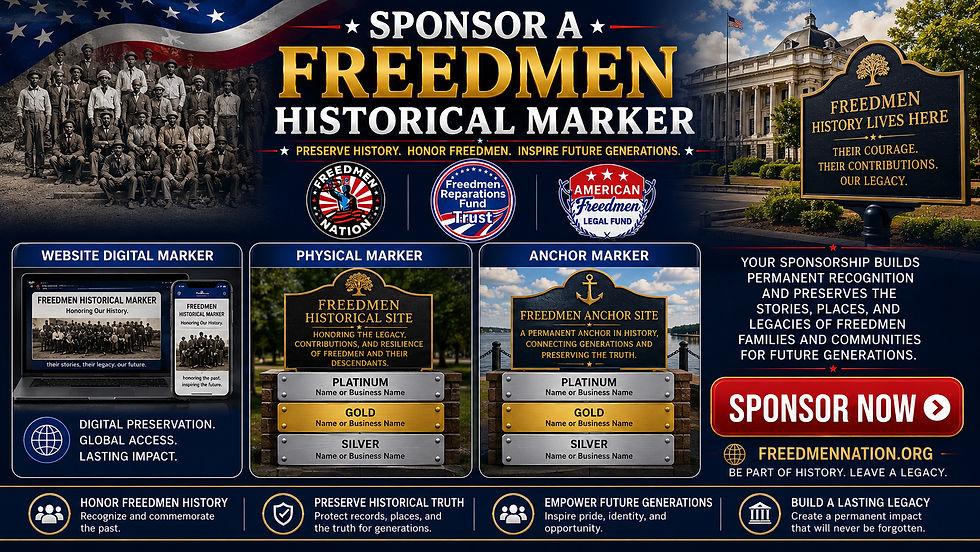
Sponsor a Freedmen Historical Marker
History should not remain buried in archives.
The Freedmen Reparations Fund Trust is working to identify, document, preserve, and commemorate Freedmen families, communities, cemeteries, institutions, land histories, and other historically significant locations throughout the United States.
Individuals, families, businesses, and institutions can help preserve this history by participating in the Sponsor a Freedmen Historical Marker initiative.
Marker sponsorship helps transform historical research into permanent public recognition—creating a physical record that future generations can see, visit, study, and preserve.
A Freedmen Historical Marker can help:
Preserve the history of a Freedmen family or community;
Identify historically significant land, cemeteries, churches, schools, institutions, and settlements;
Create a permanent public record of Freedmen presence and contribution;
Connect present-day successors to documented historical places and events; and
Protect important history from being forgotten, erased, redeveloped, or disconnected from the people whose families created it.
Place your name, family, business, or institution in history by helping sponsor a
Freedmen Historical Marker.
The records survived.
The successors survived.
Now the history must be preserved.


Either the Feds are with our Ancestral Jurisdictional, DC Freedmen Bank continous, Banl President Fredrick Douglass...Or our Freedmen Nation Independent PMA Charter our own Deposit and Savings Institution. Lolly-Gagging, the US Congress/Senate came to Freedmen Rescue and executed the consitution only once in our history. They were the 38-39 Congress. Under the 13th Executive Order By Our President Abe Lincoln...And Excuted by his Trusted, Courageous General, NYC Ulysees S. Grant, and his Field General T. Sherman "Battle Of Atlanta" and Grantor of our first Reparations, 40 acres and a mule to his 1200 Freedmen Combat Veterans, and 40,000 more Freedmen and their families from SC, GA, FL.
All other US Congressmen since have played spoiler alert, and delay, delay, stalling…